Three short examples of how I approach signal-processing work: define the problem,
build a reference, implement it, measure the real system, and keep the limitations visible.
Case 1 • DSP → FPGA → RF measurement
Zynq QPSK modem: closing the loop from model to a two-board RF link
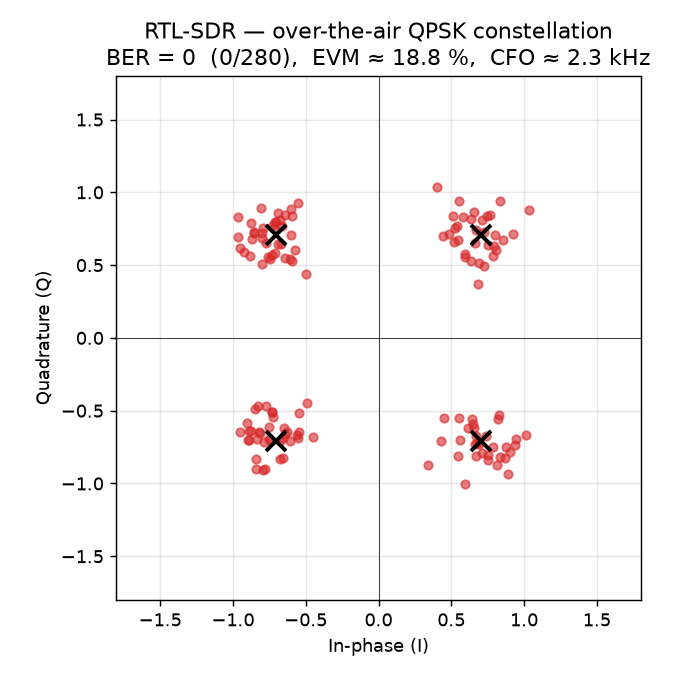
Measured QPSK hardware evidence from the public Zynq/AD936x validation flow. Repository links below lead to the retained reports and limits.
Problem
A communication-chain model is useful only if the same behavior can survive fixed-point choices,
HDL integration, real clocks, RF impairments and measurement. The goal was to make that complete
path observable rather than treating the FPGA as a black box.
Approach
Build the chain incrementally: reference DSP and fixed-point reasoning, deterministic RTL checks,
Zynq/AD936x integration, controlled two-board RF tests, IQ capture, and quantitative BER/EVM/CFO evidence.
Implementation
In-fabric BPSK/QPSK modem, synchronization and measurement workflow on independent Zynq-7020 + AD936x boards.
Verification
5.6 million fabric-loopback bits with zero errors; HDL checks, machine-readable results, timing/resource reports and IQ metadata.
RF result
Two-board 915 MHz cabled QPSK link with the promoted differential receiver reporting payload BER around 4×10⁻⁴; additional retained external-QPSK sessions include 0/25,200 recovered-bit errors.
Limit
The public evidence is strong for reproducible engineering closure, but long-duration BER-floor characterization and broader attenuation sweeps remain separate measurement work.
What this demonstrates for a client
I can connect algorithm design, fixed-point implementation, HDL/FPGA integration and real RF measurements
under common acceptance criteria. The deliverable is not only RTL or a MATLAB model; it is a traceable
engineering result with evidence and known limits.
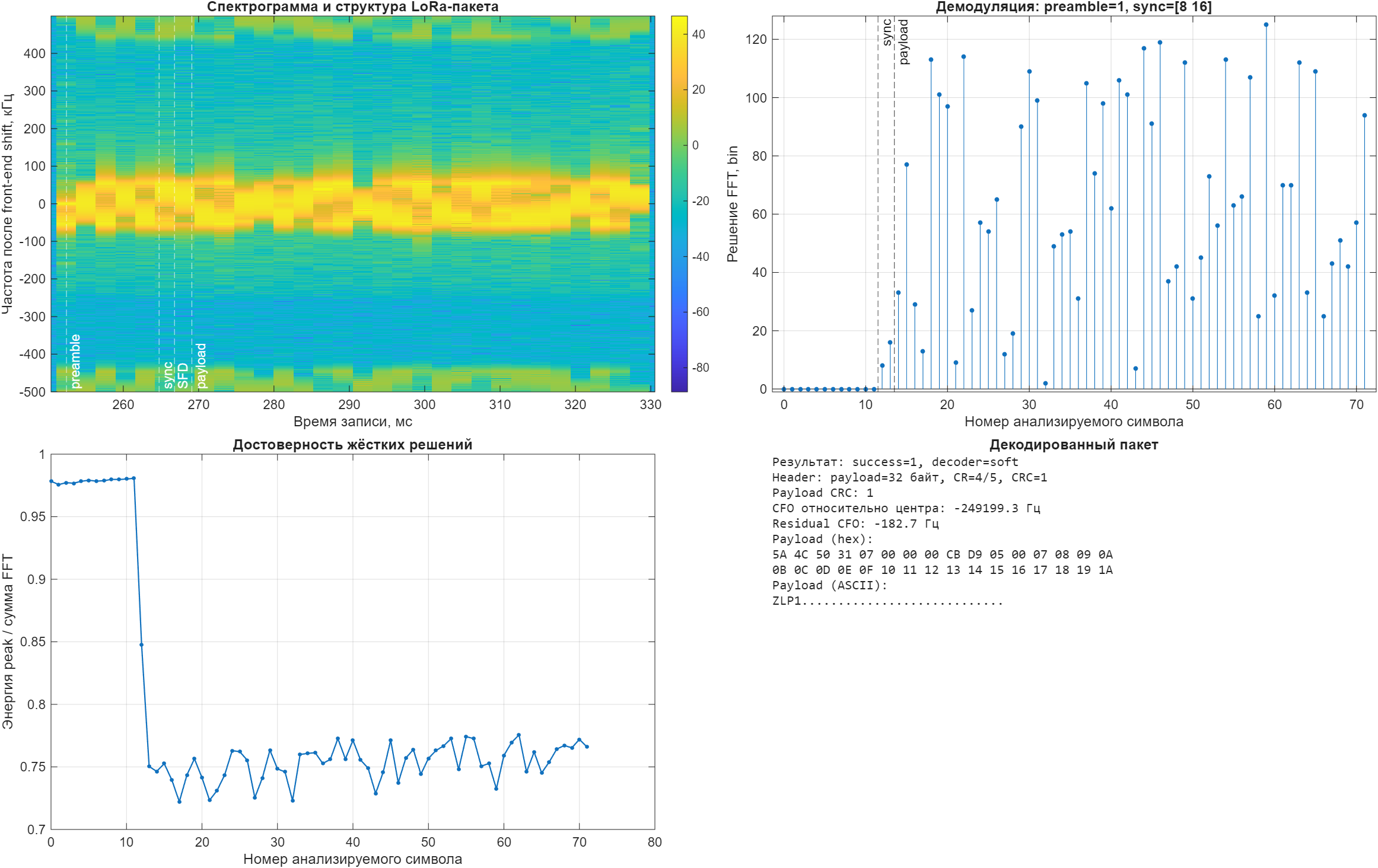
Real SX1262 packet demodulation used in the public LoRa PHY work. Hardware TDoA remains explicitly separated from the demonstrated packet-RX and timebase evidence.
Problem
A positioning-capable LoRa receiver needs more than payload decoding. Packet detection, sample-grid
alignment, timestamp definition and receiver state must be observable enough to explain timing errors
before those errors are propagated into TDoA.
Approach
Maintain one traceable path from MATLAB floating-point reference through fixed-point Simulink,
generated HDL and a routed ZynqSDR image. Capture raw IQ and PL trace data together so hardware misses
and timing defects can be reproduced instead of guessed.
Hardware RX
Real over-the-air Heltec V4.3/SX1262 packets decode on ZynqSDR with valid explicit header and payload CRC.
Long run
M9 hardware campaign: 492/492 captured packets passed CRC with zero detection misses in the 500-attempt series; combined with the overnight run, the evidence reaches 732/732 CRC-valid packets with zero misses. Failures outside the receiver are tracked separately.
Timing
M9 publishes the joint CFO-free timestamp: series500 residual mean +0.001 sample, every residual within ±0.5 sample (sd 0.285). The continuous PL sample-time counter was also verified across 47 captures spanning 803.7 seconds.
Limit
Controlled cable-delay calibration, common-time synchronization across receivers and calibrated hardware multi-receiver TDoA are still open.
What this demonstrates for a client
I can investigate a hardware DSP failure across the complete stack: model, RTL, timing, board image,
acquisition tooling and measurement data. The workflow preserves failure evidence and distinguishes a
hypothesis from a measured result — important for SDR, timing and localization R&D.
C++ DSP showcase: turning algorithms into testable, benchmarked and reusable software
C++17FIRGoertzelGCC-PHATResamplingCMake / CI
FIRGoertzelGCC-PHATResamplerAlgorithm → test → benchmark → package
No synthetic performance number is claimed here; benchmark tooling and validation evidence are linked below.
Problem
DSP code often begins as an isolated numerical prototype. For engineering use it needs deterministic
behavior, edge-case tests, performance evidence, packaging and a clear path for later fixed-point or
hardware mapping.
Approach
Implement compact C++17 DSP kernels behind a reusable API, protect behavior with deterministic unit
tests, benchmark performance-sensitive paths, keep optional AVX2 acceleration explicit, and export an
installable CMake package for downstream projects.
Algorithms
FIR design/filtering, direct and FFT overlap-save convolution, Goertzel, GCC-PHAT delay estimation and rational L/M resampling.
Verification
Deterministic unit tests, generated benchmark reports, multi-platform CI, sanitizer checks and CodeQL.
Reuse
Installable CMake package export and documented downstream use through the public dsp_core::dsp target.
Limit
The repository is deliberately compact: it demonstrates engineering discipline around selected kernels rather than claiming to be a complete DSP framework.
What this demonstrates for a client
I can move signal-processing logic into maintainable C++ without losing numerical traceability:
implementation, tests, performance measurement, packaging and possible FPGA direction are treated as one
engineering problem rather than separate tasks.
I am open to focused diagnostics, model/implementation audits, model-to-C++/RTL work and part-time R&D support
in DSP, SDR, communications and FPGA-oriented projects.