DSP Basics
Block 3. DSP Basics
Purpose
Block 3 moves from signal interpretation to active IQ processing: FFT discipline, windowing, filtering, digital mixing, multirate processing and basic quality metrics.
Why this block matters
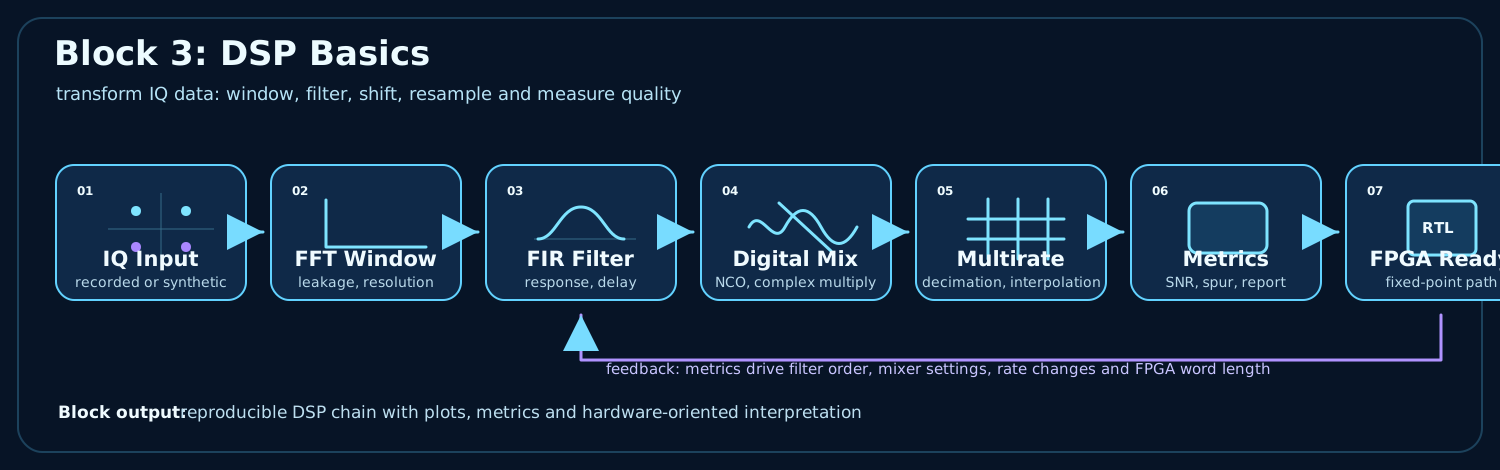
Block 2 teaches how to read a signal. Block 3 teaches how to modify, clean, shift and prepare the signal for FPGA implementation.
Core idea:
IQ input -> FFT window -> FIR filter -> digital mix -> multirate -> metrics -> FPGA-ready DSP
Main topics
| Topic | Engineering meaning |
|---|---|
| FFT windows | leakage, resolution, measurement correctness |
| FIR/IIR filtering | frequency response, phase response, transition band, delay |
| Digital mixing | frequency shift through NCO/DDS and complex multiplication |
| Multirate DSP | decimation, interpolation, anti-aliasing, anti-imaging |
| Metrics | SNR, noise floor, spur level, engineering conclusion |
| FPGA preparation | fixed-point, latency, streaming interface, resource thinking |
Labs
| Lab | Topic | Main artifact | FPGA/RF connection |
|---|---|---|---|
| Lab 3.1 | FFT windows and leakage | spectrum comparison | measurement discipline |
| Lab 3.2 | FIR low-pass filtering of IQ data | response + filtered IQ | future FIR RTL block |
| Lab 3.3 | Digital mixing and frequency shift | spectrum before/after shift | NCO + complex multiplier |
| Lab 3.4 | Decimation with anti-aliasing filter | anti-aliasing validation | rate-change block for FPGA |
Minimum lab report
Each lab should produce not just a plot, but an engineering conclusion:
- processing goal;
- signal parameters and
Fs; - plot before processing;
- plot after processing;
- numerical metric or observation;
- implication for FPGA/RF implementation.
Engineering result
After the block, the student can:
- select FFT windows for measurement tasks;
- design a simple FIR filter;
- explain delay and transition bandwidth;
- shift a signal in complex baseband;
- perform decimation/interpolation without destroying the spectrum;
- connect a DSP block to future fixed-point/HDL implementation;
- report DSP results reproducibly.
Connection to later blocks
Block 3 prepares DSP primitives that later become fixed-point and HDL blocks:
- FIR -> streaming FIR RTL;
- digital mixer -> NCO + complex multiplier;
- decimation -> anti-aliasing + rate-change path;
- metrics -> automated validation and reports.