Lab 2 — AM/FM → Spectrum → Bandwidth
Lab 2 extends the tone experiment into classical analog modulation. The goal is not only to generate AM/FM signals, but to compare model expectations with measured spectrum and bandwidth.
Goal
baseband signal → AM/FM model → RF transmission → spectrum capture → bandwidth decision
Experiment flow
flowchart TB
    MSG["1. Message signal<br/>tone, audio fragment or sweep used as the modulation input"]
    MODEL["2. AM/FM model<br/>MATLAB / Simulink reference waveform and expected spectrum"]
    TX["3. RF transmission<br/>Zynq + AD9363 carrier, gain and analog bandwidth settings"]
    RX["4. External observation<br/>RTL-SDR / HDSDR spectrum, waterfall and level check"]
    IQ["5. IQ recording<br/>captured samples with documented Fs, Fc and gain metadata"]
    FFT["6. Offline spectral analysis<br/>FFT, sidebands, bandwidth and leakage checks"]
    DEC["7. Engineering decision<br/>modulation index, deviation, gain and sample-rate tuning"]

    MSG --> MODEL --> TX --> RX --> IQ --> FFT --> DEC
    DEC -. tune modulation index .-> MODEL
    DEC -. tune RF gain .-> TX
What to compare
| Item | AM | FM |
|---|---|---|
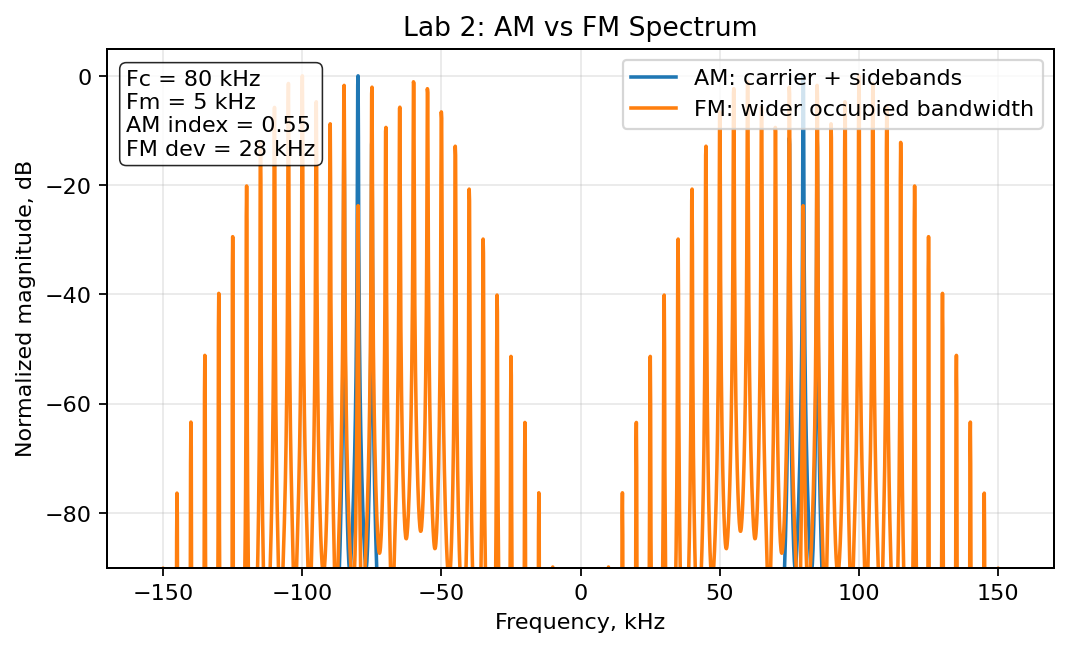
| Main observable | carrier and sidebands | occupied bandwidth |
| Main tuning parameter | modulation depth | frequency deviation |
| Typical problem | overmodulation | too large deviation |
| Metric | sideband level | estimated occupied bandwidth |
Common failure modes
| Symptom | Likely reason | Action |
|---|---|---|
| AM carrier dominates everything | modulation depth too small | increase modulation depth carefully |
| AM envelope distortion | overmodulation or clipping | reduce modulation depth or gain |
| FM spectrum too wide | excessive frequency deviation | reduce deviation |
| asymmetric spectrum | IQ imbalance, DC offset, LO leakage | check receiver and RF settings |
Demo figure
Minimum report
- Modulation type and parameters.
- TX/RX sample rates and RF frequency.
- Captured spectrum plot.
- Bandwidth estimate.
- Explanation of mismatch between model and measurement.
Engineering takeaway
Lab 2 teaches that modulation is not only a formula. In real SDR work, modulation parameters are engineering trade-offs between bandwidth, power, distortion and receiver limits.