Lab 11.33 — Residual-CFO pull-in and a rejected timing hypothesis
Goal
Turn the low clean-attempt rate left by Lab 11.32 into a falsifiable diagnosis. The lab uses
the exact core_rx samples retained by the bridge BRAM, RTL replay, timing-closed Vivado
builds, and equal-budget live two-board runs. A change is accepted only if it improves the
physical link, not merely the replay.
What the captures disproved
The cyclic frame repeats every 1120 ADC samples over the live portion of the captures. No meaningful within-frame sample-clock walk is visible across a 140-symbol frame. The immediate failure was therefore not the continuous timing drift originally suspected after Lab 11.32.
One 30 kHz two-board capture reproduced the carrier failure exactly in Icarus:
| Receiver | Received | Errors |
|---|---|---|
| original Costas settings | 140 symbols | 124 / 280 bits |
KI_LOG=4, acquisition 64 symbols, tracking KP_LOG=7 |
140 symbols | 0 / 280 bits |
The tuned loop was accepted and built into the boot image. On the conducted link at +30 kHz CFO, offset 4 produced 27/40 BER=0 attempts and 39/40 full frames. This is a useful improvement, but still not a continuous BER=0 receiver.
The attractive change that was rejected
The next hypothesis was that the feedforward phase picker ranked phases while the 65-tap
matched filter was filling. A candidate waited eight symbols, accumulated the
rotation-invariant score I²+Q², and delayed the intact preamble. It passed retained-capture
replay and all QPSK top/bridge tests.
The first combinational implementation was physically invalid: WNS=-2.779 ns,
TNS=-1772.272 ns, 3113 failing endpoints. Pipelining the DSP squares reduced this to one
endpoint at -0.002 ns; post-route physical optimization closed the candidate at
WNS=+0.010 ns, TNS=0, 75,689 fully routed nets and zero routing errors.
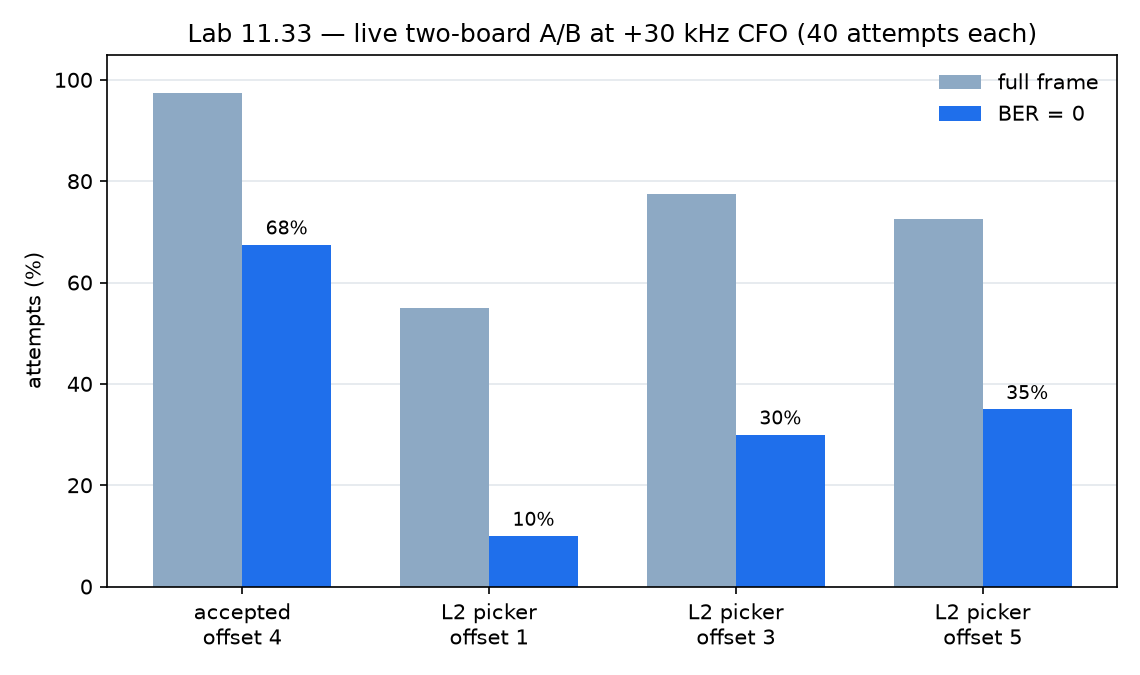
Timing closure did not make the algorithm a win. Equal 40-attempt live runs at the three candidate offsets all lost to the accepted receiver:
| Receiver | Offset | Full frames | BER=0 frames | Clean-attempt rate |
|---|---|---|---|---|
| accepted L1 burst picker + tuned Costas | 4 | 39/40 | 27/40 | 67.5% |
settled I²+Q² candidate |
1 | 22/40 | 4/40 | 10.0% |
settled I²+Q² candidate |
3 | 31/40 | 12/40 | 30.0% |
settled I²+Q² candidate |
5 | 29/40 | 14/40 | 35.0% |
The candidate was removed from RTL and from the SD card. Board B was cold-booted back into
the accepted image and rechecked: FPGA operating, core ID 0x4250534B, AD9361/XADC/capture
IIO devices present, TX at -89.75 dB.
Reproduce the evidence assembly
The hardware attempts are produced by the Lab 11.32 runner. Lab 11.33 deliberately consumes those raw per-attempt JSON files without hiding no-lock results:
python blocks/block_11_integrated_sdr_project/python/lab_11_33_residual_cfo_timing_hypothesis.py `
  --accepted tmp/lab1133_30k_fixed4.json `
  --candidate tmp/lab1133_pipeline_30k_fixed1.json `
  --candidate tmp/lab1133_pipeline_30k_fixed3.json `
  --candidate tmp/lab1133_pipeline_30k_fixed5.json
Canonical summary: lab1133_residual_cfo_timing_hypothesis.json.
Decision and next experiment
Keep the residual-CFO Costas tuning. Reject the settled squared-energy picker. The next step is a genuine continuous QPSK timing-recovery loop with explicit acquisition/tracking state, tested first against retained captures and then by a longer two-board BER campaign. The lab's main result is methodological: simulation pass plus timing closure is necessary, but live A/B evidence still has veto power.