Lab 11.51 — Acknowledgements: the sender learns what was lost
Idea
The chat of Lab 11.50 sends every line once and hopes. On the course bench at its default levels
that is enough, but turn the transmitters down and lines start to vanish without a trace: the
sender prints >>, the other board prints nothing, and nobody knows. This lab adds the oldest
remedy in data links. The receiver answers every line, and the sender repeats a line until the
answer comes. It takes about a hundred lines of C on top of Lab 11.50, and nothing changes in the
fabric.
The interesting part is what the answers cannot do. A sender that gets no answer cannot tell whether its line or the answer was lost, and on the bench that ambiguity shows up in the numbers.
The protocol
sender                                      receiver
line, sequence s     ------------------>    new s?  print it
                     <------------------    ACK, sequence s      (for every copy, new or not)
no ACK within 0.6 s: send the line again, at most 5 times
- The acknowledgement is a frame of its own. It is a packet-v1 frame like any other, with a
one-byte payload,
0x06(ASCII ACK), and the sequence number of the line it answers. A typed line never starts with that byte, so the receiver tells the two kinds apart without a type field. - The receiver acknowledges every copy. If its first acknowledgement was lost, the sender sends the line again, and a receiver that stayed silent because it had already seen the line would make the sender give up.
- The receiver prints a line once. The sequence number tells a repeat from a new line.
- Sequence numbers start at a random value. Otherwise a chat restarted on one board would begin with the numbers the other board has just seen, and its first lines would be dropped as repeats.
What you need
The bench of Lab 11.50: two boards with the image issue70-listen-window (the results below were
taken with issue69-listen-silent), two conducted paths,
/root/zmbox on both boards built from blocks/block_11_integrated_sdr_project/sw/zmbox.c.
Acknowledgements are a mode of the same program:
board-a$ ./zmbox chat --name A --arq --tx-gain -30
board-b$ ./zmbox chat --name B --arq --tx-gain -50
A link that loses lines
To see the acknowledgements at work, make the link bad. On the course bench, board A at TX -50 dB and board B at TX -71 dB lose about 40 % of the lines (the B -> A path has no splitter, so board B needs 21 dB less). A scripted exchange at those levels, recorded on the bench:
board A                                                   board B
>> A: hello, B here?                                      << A: hello, B here?
<< B: yes, hearing you, A                                 >> B: yes, hearing you, A   (acknowledged after a repeat)
>> A: loud and clear   (no acknowledgement after 5 tries)
<< B: what carrier?                                       >> B: what carrier?   (acknowledged after a repeat)
>> A: 915 MHz, conducted   (acknowledged after a repeat)  << A: 915 MHz, conducted
<< B: nice. signing off                                   >> B: nice. signing off
>> A: bye   (acknowledged after a repeat)                 << A: bye
(The two consoles are shown side by side; the lines were fed in by a script, so the typed text itself does not appear.) Four lines needed a repeat and arrived. "loud and clear" did not arrive in 5 tries, and board A said so. That is the whole gain: a lost line is no longer silent.
The same comparison, counted, with the script of Lab 11.50:
cd blocks/block_11_integrated_sdr_project/python
python two_board_chat.py --rounds 60 --tx-gain-a -50 --tx-gain-b -71 --json-out plain.json
python two_board_chat.py --rounds 60 --tx-gain-a -50 --tx-gain-b -71 --arq --json-out arq.json
On the course bench, two runs each, 100 rounds in total:
| A -> B | B -> A | |
|---|---|---|
without --arq |
60 of 100 | 61 of 100 |
with --arq |
100 of 100 | 99 of 100 |
With --arq, 52 of board A's lines and 45 of board B's needed at least one repeat. No line arrived
corrupted, and none was printed twice. At the default levels the acknowledgements cost almost
nothing: 30 of 30 lines each way, 4 repeats in all.
When the answer is what gets lost
In those 100 lossy rounds the senders reported "no acknowledgement after 5 tries" 8 times. Only one of those lines was really lost. The other seven had arrived, and what never got back was the acknowledgement. The sender has no way to tell: in both cases it simply hears nothing.
This is not a bug in the chat. Over a link that can lose frames in both directions, no finite exchange of messages lets both ends be certain of the same thing; every acknowledgement would need an acknowledgement of its own. A protocol picks what it can promise instead. This one promises that a line the sender reports as acknowledged has arrived, and that a lost line is never silent. It does not promise that "no acknowledgement" means "not delivered".
Both directions have to work
The same comparison over a range of levels, board B always 21 dB below board A, 40 lines per point:
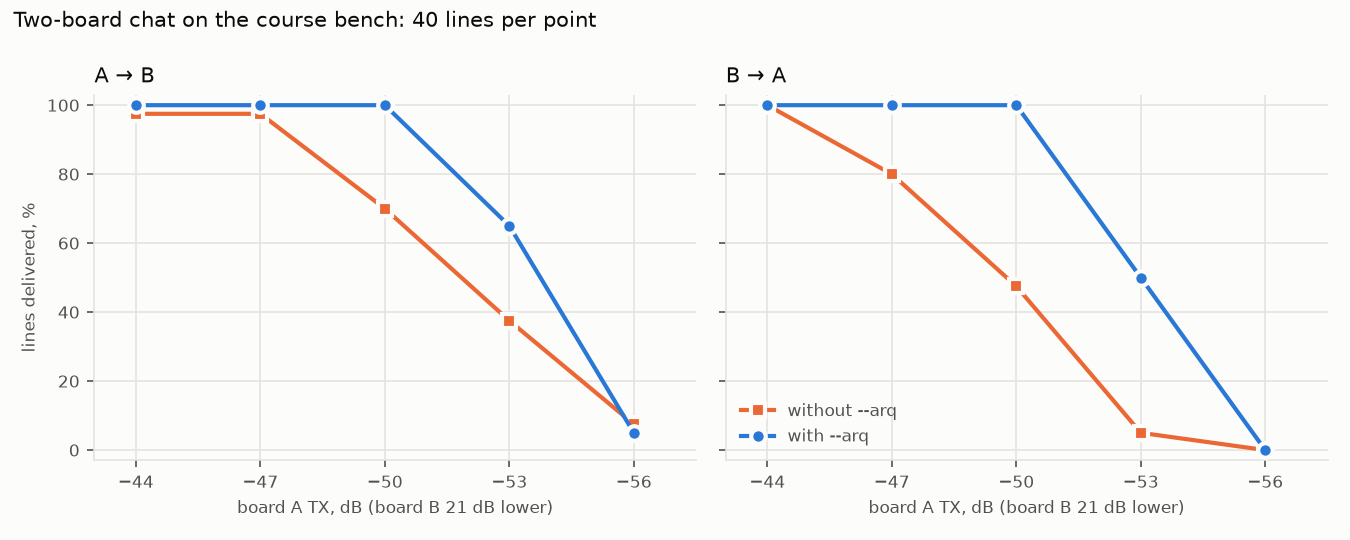
Down to board A at -50 dB the acknowledgements deliver every line, where the plain chat loses up to half. One step lower, at -53/-74 dB, something new appears. Board B printed 26 of board A's 40 lines, yet board A reported 36 of its lines as not acknowledged. The acknowledgements for board A's lines travel from B to A, and at that level the B -> A direction delivered 2 lines of 40 on its own. A protocol that relies on answers is only as good as the weaker of its two directions.
Things to try
- Type on both boards at the same moment. The modem is half duplex: while a board sends and hears
its own burst, it cannot receive, so the two first tries collide. On the course bench this cost
almost every line of board B one repeat, but no line was lost, and a random extra wait before
each repeat (
zmboxadds up to 0.5 s;ZMBOX_ARQ_BACKOFF=0turns it off) made no measurable difference: after the first collision the two boards are no longer in step.two_board_chat.py --arq --b-offset 0runs this. - Change
ARQ_TRIESorARQ_WAIT_Sinzmbox.c. Fewer tries lose more lines; a shorter wait sends repeats before the acknowledgement could have arrived (it needs at least the 140 ms wait of Lab 11.50 plus the burst).
Exercises
- Why does the receiver acknowledge a line it has already printed?
- What would go wrong if every chat started with sequence number 1?
- A sender reports "no acknowledgement after 5 tries". What can it conclude about the line, and what can it not?
- Repeats are sent at a fixed interval. Why can two boards that talk at the same time keep losing each other's lines, and what is the usual cure?
Answers
- Because its acknowledgement may be what was lost. The sender only knows that it heard nothing, so it sends the line again; if the receiver stayed silent about lines it already has, the sender would repeat until it gives up and then report a delivered line as lost.
- After one board restarts, its first lines would carry the sequence numbers the other board has just printed, and the receiver would drop them as repeats. Starting at a random value makes that unlikely. A protocol that must exclude it altogether agrees on the numbering at the start of a session.
- It can conclude only that no acknowledgement came back. The line may have been lost, or it may have arrived and every acknowledgement may have been lost; on the bench that happened 7 times out of 8. What it can rely on is the opposite case: an acknowledged line has arrived.
- Each board stops listening while it sends. If both start a line at about the same moment and repeat on the same 0.6 s rhythm, each repeat can fall where the other board is transmitting. The usual cure is a random back-off: wait a random time before each repeat, so the two rhythms drift apart. On the course bench the rhythms drifted apart by themselves after the first collision, and the back-off made no difference; on a busier channel it would.
Evidence
two-board-arq-20261017.md: the protocol, the one-way baseline and the lossy-link runs;two-board-link-layer-20261017.md: delivery against the level, both boards typing at once, fragments and speed;two-board-chat-20261016.md: the chat without acknowledgements.
What this lab does and does not show
It shows a link layer that turns a link losing about 40 % of its frames into one that delivers 199 of 200 lines and reports the rest, with nothing changed in the fabric. It does not show a reliable link in the strict sense: "no acknowledgement" does not mean "lost", it needs both directions to work, and the losses on the bench were not split by cause. One board pair, one carrier, conducted paths, two runs per row.
Lab 11.52 sends messages longer than one packet in acknowledged fragments and measures where the time of this stop-and-wait link goes.