Lab 8.9 — QPSK carrier recovery (decision-directed Costas loop)
Goal
Lab 8.8 ended with the open problem: an uncorrected carrier frequency offset (CFO) rotates every QPSK symbol by a growing phase, smearing the four constellation points into a ring that the hard decision cannot read (BER ≈ 0.5). This lab closes it with a carrier-recovery loop that de-rotates the ring back into four points, and shows the one twist that BPSK does not have: a residual 90° phase ambiguity.
The loop
The recovery is a decision-directed Costas loop: a streaming feedback loop with exactly the structure you would put on the FPGA (an NCO phase accumulator + a proportional-integral loop filter + a phase-error detector), the frequency-domain twin of the Gardner timing loop.
Per symbol s:
y = s · e^(−jθ)                      # de-rotate by the current NCO phase
e = sign(Re y)·Im y − sign(Im y)·Re y   # decision-directed QPSK phase error
freq += ki·e                         # integral term tracks the CFO
θ    += freq + kp·e                  # proportional term tracks the phase
The phase-error detector e is zero when y sits on a QPSK point and pushes θ toward the
nearest one otherwise, so the loop drives the ring onto the constellation grid. The integral
term freq accumulates into a constant slope that matches the CFO ramp: the bottom-left
panel below shows the NCO phase climbing along exactly that ramp.
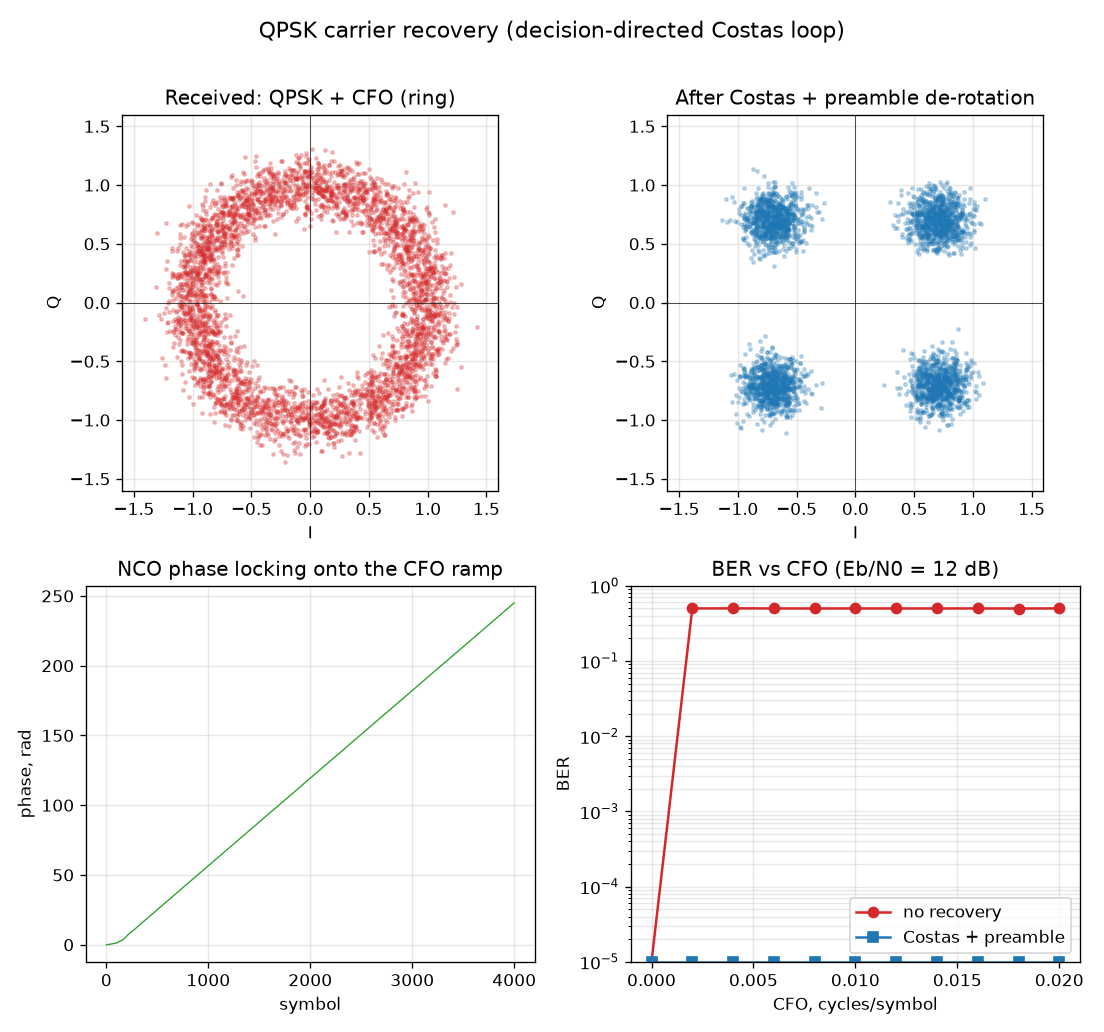
- Received (ring): QPSK + CFO, BER ≈ 0.5, undecodable.
- After Costas + preamble de-rotation: four clean clouds; CFO gone.
- NCO phase: locks onto the CFO ramp within about a hundred symbols at the plotted offset of 0.01 cycles/symbol (larger offsets take longer, see below).
- BER vs CFO: without recovery BER pins at chance for any non-zero CFO; with the loop it stays at 0 across the whole sweep.
The 90° ambiguity
A QPSK Costas loop error detector is happy on any of the four constellation points, so it
locks to one of four k·90° rotations, and which one is arbitrary. The ring becomes four
clean points, but the absolute I/Q labelling may be rotated, scrambling the bits (BER 0.25–0.5)
even though the constellation looks perfect. This is why a raw Costas BER-vs-CFO curve jumps
around.
The fix is the same known preamble / unique word the BPSK modem already uses for frame sync (the 8-bit lock word of Lab 8.8 / Block 11): try the four rotations, keep the one that matches the preamble. That is what turns the noisy curve into the flat BER = 0 line above. The script uses 32 known symbols as that preamble and scores BER only on the symbols after it. (Differential QPSK encoding is the alternative: it removes the ambiguity without a preamble, at a ~2× BER penalty.)
Reproduce
python blocks/block_08_modulation_and_synchronization/python/qpsk_carrier_recovery.py
# -> one line per CFO point (see What to expect), then
# -> raw BER @ CFO=0.01: 0.5005 | recovered: 0.0
What to expect
The BER-vs-CFO sweep sends 20 000 symbols per point at Eb/N0 = 12 dB, skips the first 1000 symbols, uses the next 32 known symbols as the preamble that picks the 90-degree rotation, and scores the remaining 37 936 bits. It also prints the pull-in time: the symbol index after the last symbol error, measured against the known data.
| CFO, cycles/symbol | 0 - 0.004 | 0.006 | 0.008 | 0.010 | 0.012 | 0.014 | 0.016 | 0.018 | 0.020 |
|---|---|---|---|---|---|---|---|---|---|
| pull-in, symbols | 0 | 21 | 68 | 95 | 315 | 268 | 477 | 384 | 650 |
| raw BER | 0 at CFO 0, else about 0.50 | 0.50 | 0.50 | 0.50 | 0.50 | 0.50 | 0.50 | 0.50 | 0.50 |
| recovered BER | 0 | 0 | 0 | 0 | 0 | 0 | 0 | 0 | 0 |
- Recovered BER is 0 at every point, over 37 936 bits each, so the claim is "below about 1e-4 per point", not "error-free".
- Pull-in grows steeply with the offset, and not smoothly: about 100 symbols at the plotted 0.01 cycles/symbol, 650 at 0.02. Beyond the loop's lock range the loop acquires by slipping cycles until the integrator catches up, and the number of slips depends on the noise.
- The 1000-symbol skip is not free. It is what keeps the preamble outside the pull-in phase. The exercises show what happens when it is shorter.
Exercises
- In
ber_vs_cfo()change the skip from 1000 to 100 symbols. Up to 0.010 cycles/symbol nothing changes, but from 0.012 up the recovered BER becomes 0.996, 0.997, 0.501, 6.95e-3 and 0.987. The preamble now falls inside the pull-in phase: the rotation it picks is right for that moment and wrong for the locked payload (a BER near 1 is a 180-degree error, near 0.5 a 90-degree one). A real receiver must place the preamble after the loop has locked, or run the loop on a long enough training sequence first. - Double the loop gains (
kp=0.04, ki=0.004): pull-in drops to 0 up to 0.012 cycles/symbol and to 211 symbols at 0.02. Halve them (kp=0.01, ki=0.001): pull-in reaches 546 symbols at 0.01 and 5643 at 0.02, and from 0.012 up even the 1000-symbol skip is too short (recovered BER 0.997, 2.5e-2, 0.500, 0.950, 0.120). What does a wider loop cost you in return? Measure the recovered EVM at CFO = 0 for both gain settings. - Change
resolve_90deg_ambiguity()to choose the rotation by the lowest BER over the whole frame, as an earlier version of this script did. Explain why the sweep result does not change here, and why that choice is still wrong for a receiver: it uses the payload as its own reference. - Differential QPSK removes the ambiguity without a preamble. Explain where its roughly 2x BER penalty comes from.
Answers (checked by running the lab script)
- The numbers are in the exercise. While the loop is still pulling in, the constellation keeps rotating; the preamble picks the rotation that is right at that moment, and once the loop locks the constellation settles somewhere else, so the payload is decoded in a different rotation (BER near 1.0 or 0.5). Resolve the ambiguity only after lock, which is why the default skips 1000 symbols.
- The numbers are in the exercise. Higher gains widen the loop bandwidth: faster pull-in and a larger capture range, at the price of more noise passed into the phase estimate. Lower gains are quieter but slower, and beyond some offset pull-in takes longer than the skip window, so the ambiguity is resolved too early again. Loop gains trade acquisition against tracking noise; there is no free setting.
- In this clean sweep both rules pick the same rotation, so the table does not change. But choosing by "lowest BER over the frame" compares the payload with the transmitted payload, which a real receiver does not have; it would report a rotation, and a BER, that the receiver could never have found. Only a known preamble (or differential coding) is a legitimate reference.
- Differential detection compares each symbol with the previous one. A noise error in one symbol corrupts both differences it takes part in, so errors come in pairs and the BER roughly doubles (and coherent differential decoding loses a little SNR on top). Lab 11.45 uses it on hardware and pays this penalty to remove the rotation problem.
Next steps
- RTL: this loop is ported to
blocks/block_05_fpga_hdl_flow/rtl/qpsk_costas.v(NCO + PI + the same decision-directed detector, a complex de-rotate at symbol rate), placed between the symbol sampler and the hard decision. It de-rotates the four-point constellation on-chip and is exercised by thetb_qpsk_rx_costasandtb_qpsk_costas_stresstestbenches, mirroring how the Gardner timing loop ported. - Hardware: the loop is part of the in-fabric receiver validated over the air in
Lab 11.4, where differential QPSK plus a preamble
removes the
90°ambiguity (Lab 11.45). For the raw over-the-air constellation seen from an independent receiver, compare with Lab 8.15.